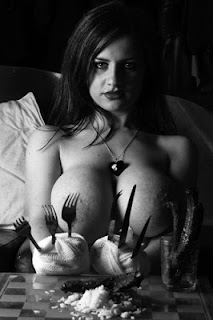
Decadence in art
Sin is no sin when virtue
is forgot.
It is so good in sin to keep in sight
The white hills whence we fell, to measure by . . .
Ah, that's the thrill! . . .
First drink the stars, then grunt amid the mire.
Richard Le Gallienne, from
"The Décadent to His Soul"
"Decadence"
conjures various images of 1890s England:
1. "Perversity" and "degeneration" in life and art (celebrating the
"unnatural" and "unhealthy")
2. A devotion to artifice (fetid hothouses), where monstrous and seemingly
artificial orchids are cultivated as a challenge to nature and assertion of
human cunning
3. An artistic and literary protest against a spiritually bankrupt civilization
4. Experimentation in life and art (a Blakean belief that "the road of
excess leads to the palace of wisdom")
In the broad sense, a
historical period marked by decline or decay. The term became associated with a
group of 19th-century, fin-de-siècle authors/artists who sought inspiration,
both in their lives and in their writings, in aestheticism (art for art's
sake). In reaction to the naturalism of the European realists, the decadents
espoused that art should exist for its own sake, independent of moral and
social concerns. The epithet was first applied in the 1880s to a group of
self-conscious and flamboyant French poets, who in 1886 published the journal Le
Décadent. The decadents venerated Baudelaire and the French symbolists, the
group with whom they are often mistakenly identified. In England the decadent
movement was represented in the 1890s by Oscar Wilde, Ernest Dowson, and Aubrey
Beardsley (read "Ballad of a
Barber" here) and the writers of the Yellow Book. J. K.
Huysmans's À Rebours (1884) and Wilde's Picture of Dorian Gray
(1891) present vivid fictionalized portraits of the 19th-century decadent-his
restlessness, his spiritual confusion, and his moral inversion.

Aesthetes and Decadents of
the 1890s
Points of Departure
1.
Assumptions underlying much of the poetry, fiction, and art
An
(anti-Romantic) belief in original sin and in fallen man and nature;
omnipresence of evil and the grotesque; lack of health, balance, and innocence.
2.
Mood and tone
• ennui
• incompleteness
• nostalgia
• sense of loss
• exile
• isolation.
3.
Imagery
• trance and dream
• life as a drama, dance, or puppet
show
• jewels and instances of extreme
artifice (the anti-natural), such as (a) masks, (b) Byzantine goldwork, and (c)
cosmetics, and (d) the dandy;
• particularly ornate, perverse, or
unnatural examples of natural phenonena, such as orchids and peacocks.
• perverse people, customs, and
events in ancient Rome and Egypt
• instances of transience (butterfly,
flower, sunset, autumn, self).
4.
Goal or theme
Incomplete
and unsuccessful attempts to escape the human condition by means of posing,
artifice, and evil, all of which are conceived of as unnatural and therefore
better than nature.
5.
Techniques
An
emphasis on brief lyric forms (cp. Romanticism) and a corollary concentration
upon intense moments, climaxes of insight, or spots of time and memory.
These
epiphanies and perfect moments often connected with landscapes or scenes, thus
preserving an instant of time in an "artificial" form (compare
Tennyson's "Mariana").
Central
technique of implicit contrast that often involves both extreme or hyperbolic
juxtapositions and a reference to standards or beliefs for intense effect in
which the speaker supposedly does not believe. As Richard Le Gallienne writes in
"The Décadent to His Soul" (English Poems,1892), "Sin is no sin
when virtue is forgot. / It is so good in sin to keep in sight. . . Ah, that's
the thrill!
A
corollary use of allusion almost entirely for emphasis or effect -- as opposed
to more traditional allusions both for effect and also to locate a work or
statement ideologically. Thus, whereas Wordsworth or Tennyson use complex
allusions to Christianity as a means of communicating their own more or less
orthodox belief, Decadents like Dowson do so more for the impact produced by
taking something religious, say, a sacrement, for an aesthetic effect. This
technique, which the Decadents often use to make themselves appear
self-consciously naughty, become a staple of Modernism.
Artists and Writers
• Konstantin Balmont
• Charles Baudelaire
• Franz von Bayros
• Aubrey Beardsley
• Max Beerbohm
• Mateiu Caragiale
• Jan Frans De Boever
• Remy de Gourmont
• Ernest Dowson
• Gabriele
d'Annunzio
• Guido
Gozzano
• Joris-Karl
Huysmans
• Vojislav
Ilić
• Alfred
Kubin
• Comte
de Lautréamont
• Jane de
La Vaudère
• Arthur Machen
• Octave Mirbeau
• Robert de Montesquiou
• George Moore
• Gustave Moreau
• Edvard Munch
• Gérard de Nerval
• Vincent O’Sullivan
• Rachilde
• Odilon Redon
• Charles Ricketts
• Arthur Rimbaud
• Frederick Rolfe
• Félicien Rops
• Georges Rodenbach
• Arthur Schnitzler
• Eric Stenbock
• Franz Stuck
• Arthur Symons
• Emile Verhaeren
• Paul Verlaine
• Auguste Villiers de l'Isle-Adam
• Oscar Wilde
References:
Victorian web
Decadence